How to Sell Digital Products Online Without a Website (2026 Complete Guide)
You don't need a website to sell digital products in 2026. Here's the complete guide — what to sell, which platform to use, how to deliver automatically, and how to hit your first $1,000.

The idea that you need a website to sell digital products online is one of the most persistent myths in the creator economy. In 2026, the reality is the opposite: websites are a liability for solo creators. They cost money, require maintenance, need traffic, and take months to build properly.
You can start selling digital products today, from a storefront that lives at a single URL, with zero monthly fees and automatic delivery — and your first customer can check out in under a minute. This guide covers everything: what to sell, how to set it up, how to automate delivery, and how to drive traffic from social media.
Creators who sell digital products earn on average 6.8x more per hour than creators who rely solely on brand deals. Digital products have zero fulfillment cost and infinite scalability — you create once and sell forever.
Why Digital Products Beat Physical Products for New Creators
Before you pick a product, understand the economics. Physical products require inventory, storage, packing, shipping, and returns. Every sale costs you time and money in fulfillment. A returned package is a net loss.
Digital products invert this completely:
- Zero cost of goods — once created, each copy costs nothing to produce
- Instant delivery — buyers receive their file in seconds, not days
- Global reach — a buyer in Tokyo and a buyer in Toronto get the same product at the same moment
- No inventory limits — sell 1 or 10,000 units without changing anything about your operation
- High margins — a $47 ebook costs $0 to fulfill; a $47 physical product might cost $15–$20 to ship
The trade-off is that you need to create something genuinely valuable. But if you have knowledge, skills, or creative output, you already have the raw material.
10 Digital Products You Can Create This Week
You do not need to build a course or write a book to start. Some of the best-selling digital products take a few hours to create:
- PDF guide or ebook — document what you know in 20–50 pages. Niche guides ($9–$49) outsell general ones every time.
- Canva template pack — Instagram post templates, pitch deck slides, business card designs. Sell 10 templates for $19.
- Notion dashboard — content calendars, business trackers, client management systems. High demand, low competition.
- Lightroom preset collection — photography and travel creators sell these for $15–$79 per pack.
- Excel or Google Sheets spreadsheet — budget trackers, social media analytics sheets, freelance rate calculators.
- Audio sample pack — producers and musicians buy loops and samples constantly. A pack of 50 samples sells for $20–$100.
- Mini video course — 3–5 short videos teaching a specific skill. Host the videos privately and deliver the link as the digital product.
- Font or graphic resource — designers pay for quality fonts, icon packs, and illustration sets.
- Swipe file or prompt library — AI prompt packs, sales email swipe files, social caption templates.
- Digital print or artwork — downloadable wall art, printable planners, coloring pages for kids.
Pick the one that best matches what you already know. Your first digital product does not need to be perfect — it needs to solve one specific problem for one specific type of person.
How to Sell Digital Products Without a Website: Step-by-Step
Here is the exact process to go from idea to first sale without touching a website builder, writing code, or paying for hosting:
Step 1: Create your product file
For a PDF: use Canva, Google Docs, or Notion. Export as PDF. For templates: create in Canva or Figma and export with a share link or packaged file. For audio: export your DAW project as WAV or MP3. Keep the file under 500MB for fast downloads.
Step 2: Set up your free SellFlow storefront
Go to sellflow.bio, sign up for free, and set your username. This becomes your public storefront URL. No credit card required, no trial period — the free plan is permanent.
Step 3: Add your digital product
In your SellFlow dashboard, create a new product. Add the product name, description, price, and upload your file or paste a delivery link. Toggle "Digital Product" on. SellFlow stores your file securely and generates a private download link for each buyer after purchase.
Step 4: Set your price strategically
Pricing digital products is counterintuitive: low prices do not increase sales volume proportionally. A $27 guide often outsells the same guide priced at $7, because higher prices signal higher quality. Start at a price you can justify with your content, not a price you think will be "safe."
Step 5: Add your store link everywhere
Copy your SellFlow URL and paste it into: Instagram bio, TikTok bio, YouTube channel description, WhatsApp status, Twitter/X bio, Pinterest profile, email signature. One link, every channel.
Step 6: Create content that drives product traffic
Post content on your social channels that demonstrates the value of your product without giving everything away. A preview, a result, a before/after — anything that makes someone think "I want that." End every post with a call to action pointing to your bio link.
Automatic Digital Delivery: How It Works
The biggest concern new creators have about selling digital products is delivery. Will they have to manually send files to every buyer? What if someone buys at 3am?
SellFlow handles delivery automatically. Here is the sequence after a buyer completes checkout:
- Payment is confirmed by the payment processor
- SellFlow generates a unique, time-limited download link for that buyer
- The buyer receives their download link via email within seconds
- The buyer also receives a WhatsApp message with the link (if they provided a phone number)
- You receive a notification that a sale was made
You do not need to be online. You do not need to check anything. A sale can happen while you sleep, and the buyer gets their product instantly. This is the compounding power of digital products — your income is not limited by your working hours.
Pricing Your Digital Products to Maximize Revenue
The right price is not the lowest price. Here is how to think about digital product pricing:
Value-based pricing
Price based on the outcome your product delivers, not the time you spent creating it. If your Notion business tracker saves a freelancer 3 hours per week, it is worth $49 — not $9 because it only took you 4 hours to build.
Price anchoring
Offer two or three tiers. A basic version at $19, a complete version at $49, a bundle with bonuses at $97. Most buyers pick the middle option. The higher tiers also make the lower tier seem like a deal.
Early bird pricing
Launch your first digital product at 50% of your planned regular price for the first 48 hours. This creates urgency and rewards your most engaged followers. After the launch window, raise the price. The scarcity is real — the early price is genuinely limited.
Driving Sales Without Paid Advertising
You do not need to run ads to sell digital products online. The most consistent revenue for creator-sellers comes from organic content and email/WhatsApp lists. Here is the playbook:
- Teach one thing from your product per post — if your ebook has 10 chapters, each chapter becomes a post. The posts build desire for the full product.
- Show results — your own results or your customers'. Screenshots, before/afters, specific numbers. Proof beats claims.
- Use Stories for direct promotion — Instagram Stories convert better than feed posts for direct product promotion. Use the link sticker to go directly to your product page.
- Collaborate with other creators — offer to give away one copy of your product to a collaborator's audience. Cross-promotion is the fastest way to reach buyers who do not know you yet.
- Collect buyer testimonials — after delivery, message buyers and ask what result they got. A real testimonial is the highest-converting piece of content you can share.
Your First $1,000 in Digital Product Sales: A Realistic Path
Here is what hitting $1,000 actually looks like for a new creator:
- One ebook at $29 → 35 sales
- One template pack at $19 → 53 sales
- One course at $97 → 11 sales
Any of these is achievable with an engaged following of 1,000 people — which is well within reach for most creators within their first few months of consistent posting. The key variable is not your follower count; it is how relevant your product is to the people who already follow you.
Start with one product. Price it fairly. Promote it consistently. Let SellFlow handle the checkout and delivery. Your only job is to create content that demonstrates why your product is worth buying.
Create your free storefront and upload your first digital product at sellflow.bio — no website required, no fees, no excuses.
Frequently asked questions
Can I sell digital products without a website?
Yes. Platforms like SellFlow give you a hosted storefront, payment processing, and automatic digital delivery — all without building or paying for a website. Your storefront URL is your shop.
What digital products sell best online?
Ebooks and PDF guides, Canva and Notion templates, online courses, music and audio files, Lightroom presets and photo filters, spreadsheets, and membership access all sell consistently well. Products that solve a specific, clear problem for a defined audience convert best.
How do I deliver digital products to buyers automatically?
SellFlow sends buyers a secure download link by email and WhatsApp immediately after payment is confirmed — no manual work required from you. The delivery happens in seconds.
How much does it cost to start selling digital products?
SellFlow's free plan has no monthly fee and zero transaction fees. You pay nothing until you make a sale — and even then, you keep 100% of every sale.
Which platform is best for selling digital products without a website?
SellFlow is built specifically for creators selling through social media. It is free, takes under 10 minutes to set up, handles automatic delivery, and works for both digital and physical products. No commissions taken on any plan.
How do I promote digital products without a website?
Share your SellFlow storefront link in your Instagram bio, WhatsApp status, TikTok bio, YouTube description, and email signature. Your store URL is your promotion link — one link covers every channel.
Written by
AmitFounder of SellFlow. Writes about social commerce, selling on Instagram & WhatsApp, and helping creators turn followers into customers.
Related articles

How to Sell on WhatsApp in 2026: Complete Guide for Creators and Small Businesses
WhatsApp has 284 million active Business accounts and 175M people messaging businesses daily in 2026. Here's the complete guide to selling on WhatsApp — from your first product listing to automated order updates.
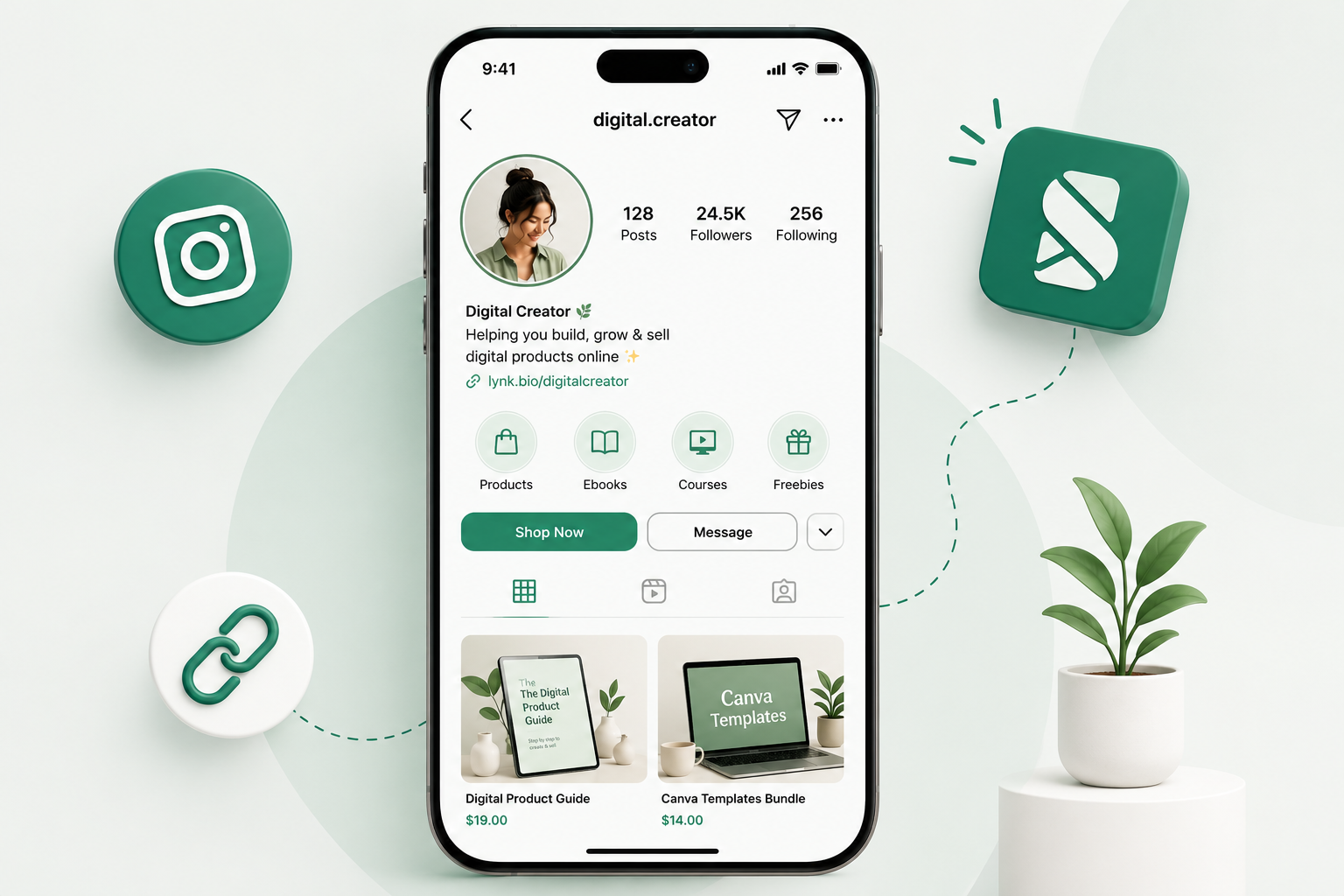
How to Sell Digital Products on Instagram in 2026 (No Website Needed)
Learn how to sell digital products on Instagram in 2026 — set up a link in bio storefront with checkout, take payments, and start earning without a website.

Social Commerce in 2026: How Smart Creators Build $10K/Month Without a Website
Social commerce is a $2.9T market. Here's the exact playbook creators use to build $10,000/month businesses from Instagram, TikTok, and WhatsApp — no website, no inventory, no agency required.
Ready to sell on social?
Turn your followers into orders with a SellFlow storefront — no payment-gateway friction.
Get started free