Social Commerce in 2026: How Smart Creators Build $10K/Month Without a Website
Social commerce is a $2.9T market. Here's the exact playbook creators use to build $10,000/month businesses from Instagram, TikTok, and WhatsApp — no website, no inventory, no agency required.

In 2026, the most effective path to building a five-figure monthly business as a creator is not launching a Shopify store, running Facebook ads, or landing a book deal. It is social commerce: selling products directly through the social media platforms where you already have an audience, using a creator storefront as the commerce layer.
This is not a new idea. But the version of social commerce available in 2026 is significantly more powerful than what existed even two years ago — and the creators who understand this architecture are building businesses that generate $10,000 to $50,000 per month from audiences of 5,000 to 50,000 followers.
This guide covers exactly how they do it.
The global social commerce market is projected to exceed $2.9 trillion in 2026. TikTok Shop processed $33.2 billion in GMV in 2024 alone. This is not a niche trend — it is the primary direction of consumer commerce.
What Social Commerce Actually Means in 2026
Social commerce gets conflated with two things it is not: influencer marketing (promoting someone else's products for a fee) and platform native shopping (Instagram Shop, TikTok Shop). Both are legitimate but different.
True social commerce for creators means:
- You sell your own products — not affiliate products, not brand deals
- The discovery happens on social platforms — Instagram, TikTok, YouTube, WhatsApp
- The checkout happens on your storefront — not on the platform's native shop, where they take a commission and own your customer data
- You keep 100% of the customer relationship — email addresses, WhatsApp numbers, purchase history
This distinction matters enormously. A creator selling through TikTok Shop gives TikTok a commission on every sale and has no direct relationship with buyers. A creator selling through their own storefront (linked from TikTok bio) owns every customer and pays zero platform commissions.
The $10K/Month Social Commerce Architecture
Here is the complete system that high-earning creator-sellers use. It has four components:
Component 1: A creator storefront (your commerce hub)
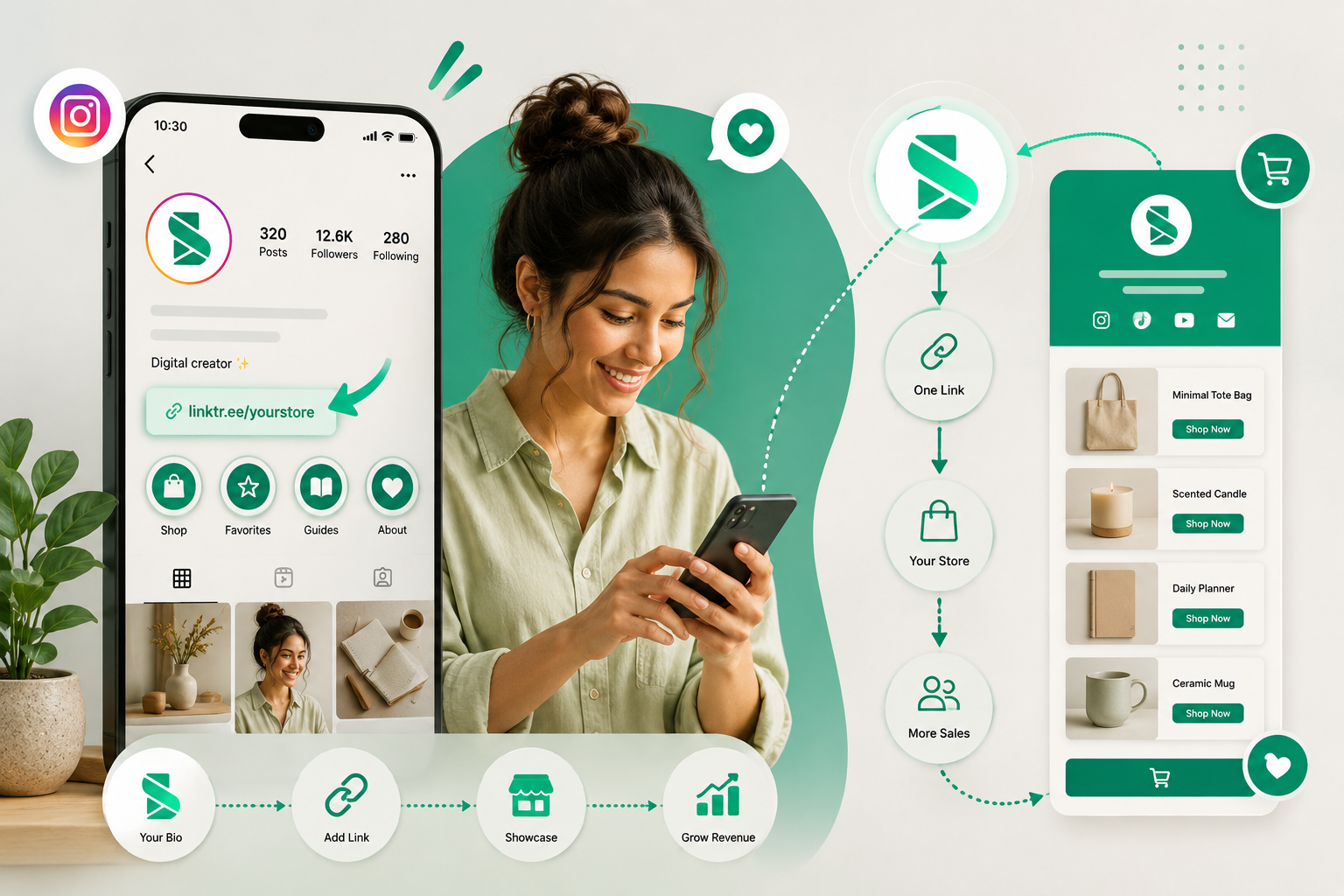
Every creator doing serious volume in social commerce has a single storefront URL that serves as their commerce hub. All product links, all checkout flows, all digital delivery — it all runs through this URL.
SellFlow provides this at sellflow.bio/yourname — a hosted, mobile-first storefront with a full product catalog and checkout. Free, zero transaction fees, live in minutes.
Component 2: Content that sells (your traffic engine)
Social commerce runs on content. Not ads — organic content that demonstrates your expertise and the value of your products. The best-performing creator-sellers post daily and structure their content in a ratio of roughly 80% value, 20% promotion.
The 80% value content builds the audience. The 20% promotion converts them. The key is that the value content makes the promotion feel natural — you are not interrupting someone, you are offering them the next step in a journey they have been on with you.
Component 3: A multi-platform link strategy
Your storefront URL should appear in: Instagram bio, TikTok bio, YouTube channel description, YouTube video descriptions, WhatsApp status, Snapchat story links, Pinterest profile, Twitter/X bio, email signature.
Every platform is a separate audience. They all flow to the same storefront. A single sale from each platform per day adds up faster than any single-platform strategy.
Component 4: WhatsApp for buyer communication
WhatsApp is where the transaction relationship continues after the first sale. Order confirmations, digital product delivery, status updates, new product announcements to past buyers — all of this happens more effectively on WhatsApp than email.
SellFlow automates the post-purchase WhatsApp messages. Every buyer gets an instant confirmation and delivery link without you sending a single manual message.
The Product Stack That Generates $10K/Month
$10,000/month sounds large but breaks down into manageable components. Here is one common structure:
- Entry product ($9–$19) — a low-cost digital product (template, mini guide) that converts casual followers into buyers. Target: 100 sales/month. Revenue: $1,500.
- Core product ($47–$97) — your main digital product (comprehensive ebook, course, preset pack). Target: 60 sales/month. Revenue: $4,200.
- Premium offer ($147–$297) — a high-touch product (course with community, coaching package, custom work). Target: 15 sales/month. Revenue: $3,375.
- Recurring offer ($19–$49/month) — a membership, subscription resource, or ongoing coaching group. Target: 30 subscribers. Revenue: $1,170.
Total: approximately $10,245/month from 205 transactions. With an engaged audience of 10,000 followers, this conversion rate (around 2%) is achievable. With 50,000 followers, a 0.4% conversion rate achieves the same result.
The ratio between your audience size and your revenue per follower is what determines your ceiling. Highly engaged niche audiences (5,000 people passionate about a specific topic) consistently outperform large general audiences (100,000 casual followers) in social commerce conversion.
Content Strategy for Social Commerce: What Actually Works
The creators generating the most social commerce revenue are not posting the most content — they are posting the most relevant content. Here is the content architecture that converts:
Teaching content (drives follower growth and product desire)
Teach your audience one thing from your product per post. If your product is a 30-day meal planning guide, post one meal prep tip per day. Each tip is useful on its own, but the full guide provides the system. After 30 days of tips, followers understand exactly what they would get — and they trust you enough to buy it.
Proof content (eliminates doubt)
Results from your own life or your customers. Before/after. Specific numbers. Screenshots with identifiable details (with permission). Proof content is the single highest-converting content type for direct product sales — it answers "does this actually work?" better than any product description can.
Behind-the-scenes content (builds connection)
The process of creating your product, your working environment, your mistakes and how you fixed them. Behind-the-scenes content humanizes you and differentiates you from faceless brands. Followers who feel like they know you personally are far more likely to buy from you.
Direct promotion (converts warm audiences)
Straightforward product posts: this is what I sell, here is who it is for, here is the price, here is the link. Post these less frequently than teaching content (2–3 times per week maximum) but with complete clarity about what you are selling. Vague promotional posts underperform. "Check out my new thing" is not a post. "My 47-page email marketing guide for coaches: how to write the sequence that made me $23,000 last year — link in bio" is a post.
Instagram vs TikTok vs WhatsApp: Where to Focus Your Social Commerce Effort
Each platform behaves differently as a social commerce channel:
Best for: visual products, lifestyle content, established audiences. Instagram's discovery is algorithmically limited for most creators — your Reels reach new people, but your feed posts mostly reach existing followers. The bio link is your primary conversion tool. Instagram converts well for products priced $29–$197.
TikTok
Best for: viral discovery, younger audiences, demonstration-first products. TikTok's algorithm is aggressive about showing content to new viewers — a single good video can reach 100,000 people with zero followers. Conversion from bio link works, but TikTok audiences tend to convert on lower-priced products more readily ($9–$49 sweet spot). TikTok Shop is an option but comes with platform commissions and less customer data ownership.
Best for: repeat buyers, high-trust markets (India, Southeast Asia, Africa, Latin America), and high-consideration purchases. WhatsApp has the highest conversion rate of any channel once a buyer is in your ecosystem — but it is weak for cold discovery. Use WhatsApp to deepen relationships with people who found you on Instagram or TikTok.
The optimal strategy in 2026: use Instagram and TikTok for discovery and initial conversion, use WhatsApp for repeat sales and deeper customer relationships. Your SellFlow storefront serves as the consistent anchor point across all three channels.
Why Owning Your Commerce Layer Matters
The biggest strategic mistake social commerce creators make is building their business on top of platforms they do not control. Selling exclusively through Instagram Shopping or TikTok Shop means:
- The platform owns the customer data (email, phone number, purchase history)
- The platform takes a commission on every sale (typically 2–8%)
- A platform policy change can eliminate your sales channel overnight
- You cannot retarget buyers across platforms because you do not know who they are
Owning your commerce layer — a storefront with your own checkout — means you own the customer. You know their name, their email, their order history. You can send them a WhatsApp message announcing your next product. You can give them an exclusive discount. You can ask for a review. None of this is possible if the platform owns the transaction.
SellFlow is designed on this principle: your storefront, your customer data, your revenue. The platform is the discovery channel; SellFlow is the commerce layer you own.
Getting Started: Your First 30 Days in Social Commerce
Here is the 30-day plan for a creator starting their social commerce operation from scratch:
- Week 1: Set up your SellFlow storefront, add 1–3 products, update all social bios with your store link. Post 5 pieces of teaching content related to your product.
- Week 2: Run your first promotion — early bird pricing for 48 hours. Announce it on every platform and in your WhatsApp Status. Aim for your first 5 sales.
- Week 3: Collect your first testimonials. Message every buyer and ask what result they got. Post the testimonials as social proof content.
- Week 4: Add your second product or a bundle offer. Announce it to buyers first via WhatsApp. Post proof content from week 3's testimonials.
After 30 days, you have: a live storefront, initial sales data showing which content drives conversions, your first customer testimonials, and a WhatsApp list of buyers you can market to with zero cost.
That foundation compounds. Month 2 starts with a warm list. Month 3 you launch to a list of proven buyers. By month 6, the system generates consistent revenue from the content you are already creating.
Start your social commerce operation today. Create a free SellFlow storefront at sellflow.bio — the setup is free, takes 10 minutes, and you own every customer from your first sale.
Frequently asked questions
What is social commerce?
Social commerce is selling products directly through social media platforms — using Instagram, TikTok, WhatsApp, or YouTube as the store rather than a traditional website. Buyers discover, browse, and purchase without leaving the social context where they first saw the product.
How big is the social commerce market in 2026?
The global social commerce market is projected to exceed $2.9 trillion in 2026, driven by creator storefronts, TikTok Shop, Instagram Shopping, and link-in-bio selling platforms. It is one of the fastest-growing segments in all of commerce.
What is the best social commerce platform for creators in 2026?
For creators selling their own products (not affiliate or brand deals), SellFlow is the best social commerce platform: free, zero transaction fees, works across Instagram, TikTok, and WhatsApp, mobile-first checkout, and automatic digital delivery. Takes under 10 minutes to set up.
How do creators make money through social commerce?
Creators list products on a storefront like SellFlow, share the link across their social platforms, and collect payments directly. Digital products, physical goods, and services all work. The creator keeps 100% of the revenue minus payment processing fees.
Is social commerce better than a traditional online store for creators?
For creators and solopreneurs with an existing social following, yes. Social commerce meets buyers where they already are. You do not need to build website traffic from scratch — your Instagram or TikTok audience is your customer base, and a creator storefront captures it directly.
How do I start with social commerce in 2026?
Create a free SellFlow account, add your products, and share your store link across your social profiles. Instagram bio, TikTok bio, WhatsApp status — one link covers all channels. Start selling in under 10 minutes with no upfront cost.

Written by
AmitCo-founder of SellFlow. Writes about social commerce, selling on Instagram & WhatsApp, and helping creators turn followers into customers.
Related articles

Best Creator Storefront Platforms in 2026: Honest Side-by-Side Comparison
Linktree, Taplink, Stan Store, Beacons, or SellFlow? Here's the honest comparison of every major creator storefront platform in 2026 — fees, features, and who each one is actually built for.
Link in Bio Shop: How to Turn Your Instagram Bio Into a Store in 2026
Your Instagram bio gets one link. Make it a shop. Here's exactly how to build a link in bio shop that converts followers into paying customers — free, no website needed.
![The Best Free Link in Bio Tool for Instagram & TikTok Sellers (2025) [ SellFlow ]](https://firebasestorage.googleapis.com/v0/b/sellflow-f831.firebasestorage.app/o/blog%2Fxc88r81emqs0vz19.jpg?alt=media&token=e9750723-ced2-411f-9a24-7d41d3695e90)
The Best Free Link in Bio Tool for Instagram & TikTok Sellers (2026)
The complete guide for US sellers: how to edit bio on Instagram, add a link on TikTok, compare free bio link tools, and sell directly from your bio link with SellFlow.
Ready to sell on social?
Turn your followers into orders with a SellFlow storefront — no payment-gateway friction.
Get started free